Thelephora aurantiobrunnea Kõljalg, I. Saar & Svantesson 2024
Syn.: Tomentella
rubiginosa (Bres.) Maire 1906
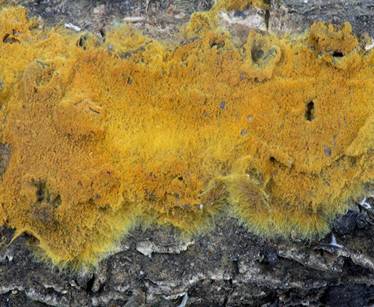
Basidiome effused, separable, araneose to byssoid in immature parts, hypochnoid,
tomentose, soft membranaceous
or somewhat crustose and brittle when old; up to 0.2 (0.3) mm thick.
Hymenophore at first
discontinuous, porulose, tufted, then granulose,
rarely with smooth or colliculose parts,
yellow-orange (5–7.5YR 6–4/8–12) when young, then orange brown to ferrugineous brown (5–10YR 4–3/4-8), rarely assuming a
faint olivaceous hue (10YR–2.5Y 5–4/4).
Subiculum scanty to rather
well developed, loose, araneose to byssoid, soft,
yellowish-orange to yellowish brown (5–10YR 7–6/8), sometimes becoming strong
brown (7.5YR 5/6–8), or even dark brown, depending on the presence, abundance
and colour of rhizomorphs.
Margin shortly thinning
out, fertile and concolour to almost sterile and
byssoid to fimbriate and then paler, yellowish to
yellow-orange.
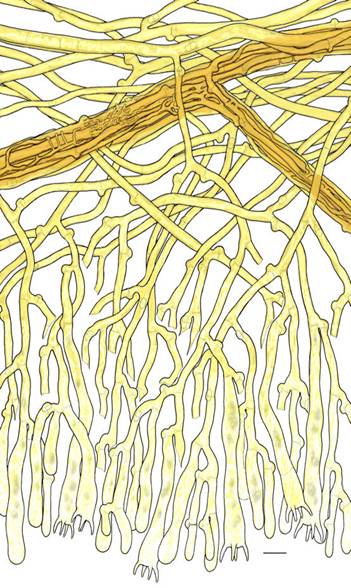
Rhizomorphs common in
subiculum, at the margin and in cracks of the substratum, up to 0.05 (0.1) mm
thick, often branched in all directions, sometimes arranged in ropes, compact,
becoming hard and rigid, with almost smooth surface, yellowish brown to dark
brown.
Hyphal system dimitic with short
skeletoid hyphae associated with rhizomorphs.
Subicular hyphae regular, fibulate, sometimes with intercalary simple septa, (2.5)
3–4 (5) µm wide, sometimes with simple anastomoses, with thin to thickening wall,
yellow to golden yellow or yellow-orange, normally branching at some distance
from septa.
Subhymenial hyphae regular, fibulate, (2) 2.5–4 µm wide, thin-walled, subhyaline, yellowish to golden yellow, often branching
from clamps.
Rhizomorphs starting as rather
loose strands of fibulate generative hyphae in
subiculum, soon mixed with some 2–3 µm wide, sinuos
and sparsely branched hyphae with thickening walls and frequent simple or
adventitious septa that end with strongly branching thin hyphae 0.5–1.5 µm wide
with thin walls and frequent simple septa. Old rhizomorphs with slightly wider
hyphae (up to 6 µm) in the core surrounded by some, relatively short, hyphae
2–3 µm in diam. as described above that forms a discontinuous compact labyrinthiform layer on the surface.
Cystidia absent.
Basidia narrowly clavate, sinuos, (35) 45–60 (80)
x 6–9 (10) µm, fibulate at the basal septum, subhyaline to pale yellowish, often with homogeneous
yellow-ochre content or guttulae; 4 sterigmata up to 6 (8) µm long and 1–2 µm wide at the base.
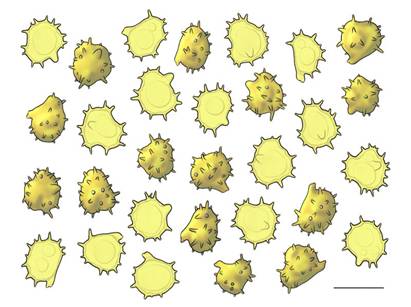
Basidiospores mostly with
irregular outline, frontal somewhat three-lobed, lateral face with regular to
sinuous outline, ellipsoid with flattening adaxial
side to two-lobed and broader toward the base, polar view subglobose to
transversally subglobose, sometimes with sinuous outline and rarely more or
less three-lobed, (6.5) 7–8 (8.5) x (5) 5.5–6.5 (7) x 6.5–7.5 (8) µm, Q1
1.1–1.4 (1.5), Q2 = 0.95–1.15 (1.2), echinulate, yellowish to yellowish brown; aculei up to 1.5 (2) µm long, tapering, not or rarely
disposed in crowns; apiculus prominent.
Incrustation: a lot of adhering
yellowish, ochraceous to reddish brown resinous
matter on basidia and subhymenial hyphae visible in water and LA, almost
completely dissolving in KOH and producing a yellowish diffusate.
Description: E. Martini
Drawings and Photo: Elia Martini