Thelephora nitellina (Bourdot & Galzin) Kõljalg, I. Saar & Svantesson 2024
Syn.:Tomentella nitellina Bourdot &
Galzin 1924
Basidiome effused,
soft membranaceous to pellicular,
loosely adherent to separable, often detached from the substrate, up to 0.5
(0.8) mm thick.
Hymenophore becoming continuous, smooth, some parts fissured on
drying, relatively compact, up to 0.1 mm thick, monostratified,
brown or with a light reddish tint (7.5–10YR 6–5/4 to 7.5–10YR 4/3–4),
sometimes with a pale greyish bloom.
Subiculum hypochnoid to
tomentose or soft-fibrous, distinct, becoming thick,
yellowish-brown to pale brown-cinnamon (7.5–10YR 6–5/4–6), more or less paler
than the hymenial surface.
Margin abrupt and fertile or indefinitely
thinning out, byssoid to araneous and sterile, concolour with the subiculum.
Rhizomorphs absent; not differentiated thin hyphal strands may be
rarely present in subiculum.
Hyphal
system monomitic;
all hyphae with mostly fibulate primary septa;
scattered simple septa may be present in subicular
hyphae.
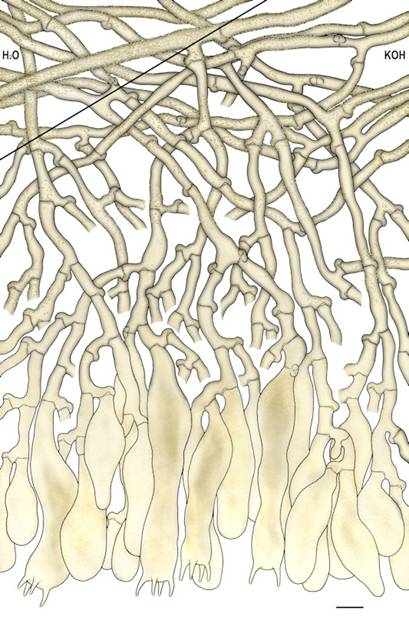
Subicular hyphae loosely interwoven, regular or almost so, (2.5)
3–6 (7) µm diam, occasionally with swollen segments
up to 10 µm, with some simple anastomoses, with thin or thickening walls
(0.3–0.8) µm, subhyaline to yellowish brown (golden
brown).
Subhymenial hyphae scanty, (3) 3.5–6 (8) µm,
mostly regular, thin-walled, subhyaline to
yellowish-brown. Remains of basidia (immature or collapsed) may
infrequently appear as intercalary hyphal swelling.
Cystidia absent.
Basidioles subclavate, ovoid to ventricose, large and distinct, (8) 9–16 (19) µm wide, subhyaline to yellowish.
Basidia ventricose to utriform, 45–75
(88) µm long, 9–13 (14) µm wide at top, (10) 13–17 (20) µm at the lower middle,
narrowed at the base and frequently shortly peduncolate,
subhyaline to pale yellowish brown, often with ochraceous content; (2) 4 sterigmata
up to 6–8 (10) µm long and (1.5) 2–3 µm wide at the base.
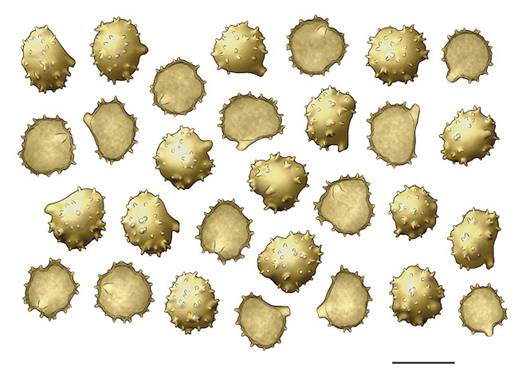
Basidiospores with irregular to slightly
lobed outline, echinulate, finely verrucose; (7.2)
8–[8.85]–9.8 (10.4) µm long; lateral face mostly irregularly
ellipsoid to broadly ellipsoid or slightly 2-3-lobed, with a flattening adaxial side, (6.4) 6.6–[7.35]–8 (8.8) µm wide, Q = (1.05)
1.1–[1.21]–1.3 (1.4); frontal face normally ± isodiametric,
irregularly subglobose to subovoid, rarely somewhat
3-4-lobed, occasionally almost star-shaped, (7) 7.4–[8.27]–9.2 (9.6) µm wide, Q
= 1–[1.07]–1.14 (1.26); in polar face globose to irregularly
globose; without guttulae, walls 0.4–0.8 µm,
yellowish brown or ochraceous, concolour
with hymenial elements in mass. Echinuli 0.3–0.6 (1) µm long and 0.5–0.8 (1.2)
µm wide at the base, mostly blunt, obtuse, single or paired at the base or
sometimes in groups of 2 to 5 over a low tubercle or wart. Apiculus toward the base of the spore, 1.2–2 (2.5) µm
across, without a distinct hilum. Macrospores infrequent, not differentiated,
11–12 x 9–9.6 x 9.8–11 µm.
description: Elia Martini
drawing: Elia Martini