Thelephora eucoerulea Kõljalg, I. Saar & Svantesson
2024 ss. orig.
Syn.: Tomentella
molybdaea Bourdot & Galzin 1924?
Basidiome: effused, adherent, up to 0.2 mm thick
Hymenophore: discontinuous to continuous, becoming strongly
granulose, smooth parts almost absent; when fresh mostly bluish grey, lilac,
dark blue
Margin: indefinitely or shortly thinning out, pruinose, concolour to slightly
paler than the fertile surface, down to whitish when fresh
Rhizomorphs: absent
Subiculum: indistinct, poorly developed, araneous,
loose
Subicular hyphae: regular or almost so, sinuous, (2) 2.5–5
(6) µm diam, normally branching at some distance from
septa, walls 0.4–1 µm thick, subhyaline to pale-light
yellowish brown
Subhymenial hyphae: regular or almost so, short-celled,
becoming compactly arranged and indistinct, (2) 2.5–5 (6) µm wide, often
branching from clamps, thin-walled, subhyaline to
yellowish, some with ochraceous content
Cystidia: absent
Basidia: narrowly clavate, subcylindrical, slightly utriform, (28) 31–48 (57)µm long,
6–9 µm wide at top, (4.2) 4.5–7 (8) µm at the lower middle, transverse septa
frequent, hyaline to yellowish, sometimes with light ochre or brownish content.
(2) 4 sterigmata 5–7 µm long and 1.2–2.5 µm wide at
the base
Spores: almost regular to irregular, occasionally more or less
lobed, echinulate, crowns absent or rare and indistinct, rarely with a large guttula, with thickening walls (0.5 µm), yellowish to ochraceous or light yellowish brown; (5.6) 6.2–7.6 (8) µm
long; lateral face
ellipsoid to broadly ellipsoid, sometimes irregular to somewhat 2-3-lobed
dorsally, adaxial side flattening, (4.5) 4.8–6 (6.4)
µm diam, Q = 1.1–1.4; frontal face triangular to broadly ovoid, sometimes faintly
3-lobed, (5.4) 5.6–7 (7.2), Q = 1–1.2; in polar view globose to irregularly globose. Aculei 0.5–1.3
(1.5) µm long,
Chemical reaction: Hymenium strong cyanescent with KOH
Distribution: considered a rare species in Germany
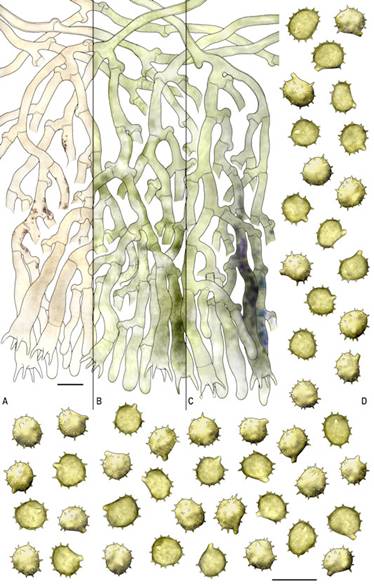
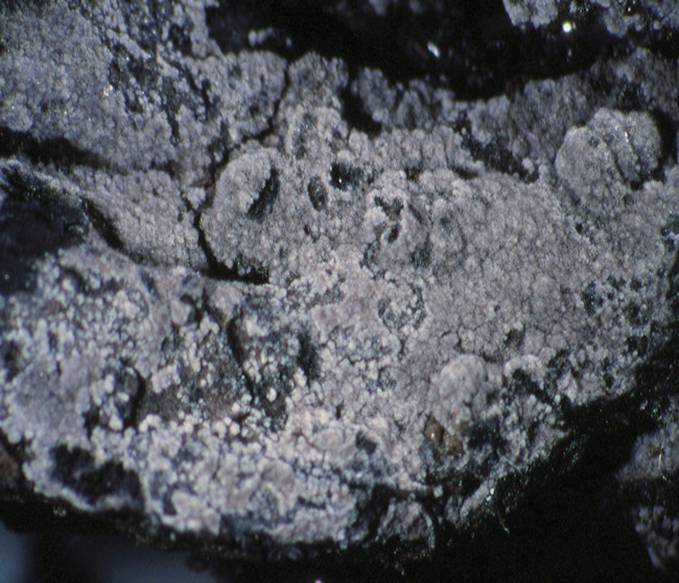
Description, Drawing and Photo: E. Martini