Thelephora fuscoferruginosa (Bres.) Kõljalg,
I. Saar & Svantesson 2024
Syn.:Tomentella fuscoferruginosa (Bres.) Litsch. 1939
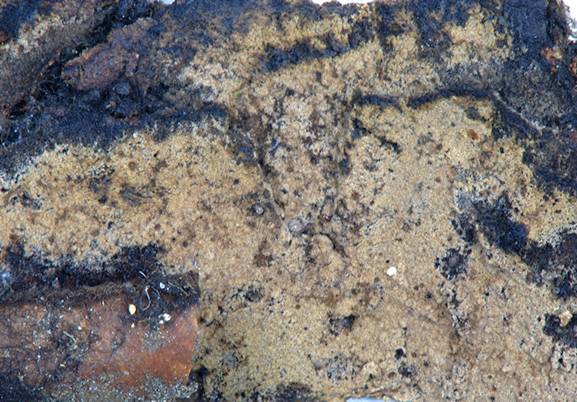
Basidiome effused, adherent,
soft membranaceous, tomentose,
0.3–0.7 mm thick.
Hymenophore becoming almost smooth and continuous, somewhat firm,
light to medium brown (10YR 6/4–4/4), some diffuse small parts becoming dull
and slightly reddish (up to 5YR 3/4).
Subhymenium normally developed, about 0.1
(0.2) mm thick, not thickening but in some parts of the type specimen may
become bi-stratified (stop and restart event).
Subiculum well developed, up to 0.5 mm thick, soft and fibrous when
fresh, loosely tomentose when dry, dark to very dark
brown, almost blackish (10YR 2/2–1), much darker than the fertile area.
Margin sterile or almost so, abrupt or shortly
thinning out, pruinose, dark brown to almost
blackish, darker than the fertile area and concolour
with the subiculum.
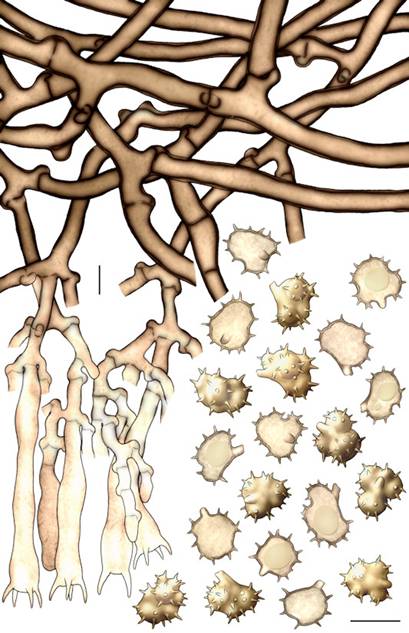
Hyphal system monomitic; all hyphae
with fibulate primary septa; some scattered simple
septa are also present.
Subicular hyphae regular or almost so, 5–10 µm wide, thick-walled
(walls 1–2 µm thick), often with some localized thickenings and 'elbow-like
bends', brownish to dark brown.
Subhymenial hyphae regular, (3.5) 4–5 (7) µm wide,
soon with thickening wall, subhyaline to pale brown.
Rhizomorphs absent.
Cystidia absent.
Basidia sinuous-cylindrical to somewhat utriform, 40–65 (75) x 8–11
µm at top, 6–10 µm at the lower middle, hyaline to pale ochre-brown; (2) 4 sterigmata 7–9 µm long and 1.5–2.5 (3) µm wide at the base.
Basidiospores with irregular to
distinctly lobed outline; lateral face irregularly ellipsoid to obliquely
pyriform, with flattening adaxial side; frontal face
triangular to 3-lobed; polar face irregularly globose to 3-lobed, 8.5–10.5 x
6.5–7.5 (8) x 7–9 (9.5) µm, Q1 = (1.15) 1.2–1.3 (1.4), Q2 =
1.05–1.2, echinulate, with thickening to thick wall, dull yellow to light
brown; aculei 1–2 (2.5) µm long and 0.5–1 (1.2) µm
wide at the base, single, sparse, rarely paired at the base, often with a large
oil drop.
Chlamydospores absent.
Incrustation: almost none; no yellow-reddish material visible in
water mounts.
Chemical reactions: IKI: some parts of subhymenial hyphae and
basidia may be amyloid; spore apiculus amyloid. KOH: elements becoming
slightly duller (loosing yellow hue). CB: thin-walled elements sometimes cyanophilous; thick-walled elements acyanophilous.
description: Elia Martini
drawing and photo::
Elia Martini